The garden's going great guns after the rain and sun.
Thursday, January 20, 2011
Chooks (Bantams) available to a good home
I offered to look after these three girls when a member of my local permaculture group moved to a flat a couple of months ago. They don't lay many eggs and I'd like to give them to a good home. Not sure how old they are, but they're very cute, healthy and people friendly. Being bantams, they're a bit smaller, and they take very little effort to look after. They eat less and poo less. Just lock them up at night. Available to collect in Ormond, as of 20/1/11. Call me on 0401 991 866.


The garden's going great guns after the rain and sun.

The garden's going great guns after the rain and sun.
Monday, January 3, 2011
The Oat Growing Experiment
Back in chilly August, I dug over half the back lawn and planted oats and peas.
(See here) The peas didn't do to well, but the oats have done okay, among many weeds and subsequently planted potatoes.
Today, 3/1/2011, we had a go at harvesting the oats.
We started by cutting the heads of the oats. I spread them out on a sheet, stomped on them and scrunched them around. The next step should have been to sprinkle them into a bowl, allowing the wind to blow off the chaff. Trouble is, these oats have husks. I should have bought a husk-less variety if I wanted to do this by hand.
This photo shows what has to be removed to get to the rolled oat at the far right. The final husk (steps three and four before the end) is too hard to remove on-mass by hand.
In the very last step, I've rolled the oat with a roller, to make it look like what you get in muesli.
So I can easily grow my own cereal, but processing it ready for breakfast is a bit harder. Too hard by hand. But not all is lost. Oats are a great source of protein, fats and other nutrients. They'll make great fodder for the chooks, off-setting feed costs. I can just put the chooks in the chook tractor on top of the oats. The are very efficient at de-husking. More importantly, we've learnt what it takes to get our porridge.
(See here) The peas didn't do to well, but the oats have done okay, among many weeds and subsequently planted potatoes.
Today, 3/1/2011, we had a go at harvesting the oats.
We started by cutting the heads of the oats. I spread them out on a sheet, stomped on them and scrunched them around. The next step should have been to sprinkle them into a bowl, allowing the wind to blow off the chaff. Trouble is, these oats have husks. I should have bought a husk-less variety if I wanted to do this by hand.
This photo shows what has to be removed to get to the rolled oat at the far right. The final husk (steps three and four before the end) is too hard to remove on-mass by hand.
In the very last step, I've rolled the oat with a roller, to make it look like what you get in muesli.
So I can easily grow my own cereal, but processing it ready for breakfast is a bit harder. Too hard by hand. But not all is lost. Oats are a great source of protein, fats and other nutrients. They'll make great fodder for the chooks, off-setting feed costs. I can just put the chooks in the chook tractor on top of the oats. The are very efficient at de-husking. More importantly, we've learnt what it takes to get our porridge.
Wednesday, December 22, 2010
Working in a Permaculture Eco-Village
How a mixed use subdivision can build natural ecosystems, resilience does exist in diversity, a look at an intentional community.
This December I had the privilege to spend five days Wwoofing (willing workers on organic farms) with Max and Trudi Lindegger at Crystal Waters EcoVillage, one hour drive inland from the Sunshine Coast, Qld.


This is a real eco-village and intentional community, designed along permaculture principles in 1988. Max and partners started this eco-village, having done Bill Mollison's first permaculture course. He now lives there, doing design consulting, training and international development aid work. Otherwise Max is looking after his bees, a few cows, nut trees and seedlings which he sells at local markets.
Crystal Waters is in many respects, is a typical subdivision of a 259 ha cattle farm. Roads, dams and all other infrastructure were constructed.
What Max and his partners did, that most developers don't do, is spend 9 months observing the site, before committing design pen to paper. They observed the property through the seasons - how water moves, ecological niches, fauna and flora, soil, sun, wind and other external energies. A business plan documented the research and the potential products (fruits/ nuts, aquaculture, agroforestry, livestock) and how they'd fit into the 'system'.

Today Crystal Waters is home to around 250 people. A standard body corporate structure, is the formal mechanism which binds the community. All the infrastructure is maintained by the body corporate, with very little involvement of the local council. It is not close to a major town, and many people work from home. The local community economy is strong, with residents often employing each other. Some locally major businesses started from Crystal Waters, such as Green Harvest Organic Gardening Supplies, or Rammed Earth Constructions.
Houses are clustered in small groups, and most of the land is set aside for nature (permaculture zone 5). There is a kind of village centre, as you turn off the main road into Crystal Waters, with a community functions centre and eco-centre training facility. There is something on most nights of the week, though there's no expectation on residents to engage in activities.

A couple of streams run though the undulating property, and Max and others have planted thousands of indigenous trees, recreating in one area, a rain-forest. And by the sound of things, they've been very successful at re-creating nature. Literally, it is very noisy (in a beautiful way) with 26 frog species, 176 bird species, noisy cicadas, wallabies along the verges (they're not noisy), but no dogs or cats allowed!
For those of you interested in the town planning principle of encouraging mixed use, this eco-village takes the idea to a new height. People are living and working in diverse ways seamlessly with nature. Even the pastures have lots of species variety, with no herbicides used, there's lots of grasses, clover, fungus and other herbs. It's easy to see how this diversity, in nature and human culture, breeds resilience. If one herb is less successful, there is another which animals can graze and so on.
As a sustainable solution for human habitation, Crystal Waters is at one end of the spectrum, giving most back to nature. Clearly at around one hectare per person, it's not housing many people and nor does it intend to. At the other end, someone living in central Manhattan uses very few resources, and is arguably just as sustainable. Where do I want to be? Not sure. Crystal Waters is more beautiful, but perhaps not as exciting (in a human kind of way:)
A well designed system, doesn't need much maintenance. That was evident from Max's six cows (and one bull). They are lowland Angus, used for their meat, saving on the milking. They are cell grazed, meaning that a grid of electric fences is used to keep them in a segment of their paddock and every two days, they're moved into the next segment. It's a simple matter of lowering the electric wire and they move into the fresh cell. This way the clover and other grasses get eaten down once, and can recover before the cows are back. Soil compaction is also less. The paddock is full of pecan nut trees, and in-fact the cows as a by-product of the system. A mobile abattoir/butcher is used to kill the cows.
Max's best cash crop though, is his honey. It tastes quite unique because of the surrounding polen the bees forage. Most honey you buy is blended from many areas. As well as the bees, Max sells thousands of seedlings at local markets. They're popular because, being grown outside, they don't keel over as soon as you plant them.

My wwoofing jobs were mainly general maintenance stuff - pruning, mowing, planting seedlings. This December, it's been hot and humid, and we had some heavy tropical rain. I was glad to dive in the dam at lunch time. Thanks Max for sharing your experience.
See more at http://crystalwaters.org.au/
Then we went off to Noosa for some traffic and culture shock, though also very pretty.

This December I had the privilege to spend five days Wwoofing (willing workers on organic farms) with Max and Trudi Lindegger at Crystal Waters EcoVillage, one hour drive inland from the Sunshine Coast, Qld.
This is a real eco-village and intentional community, designed along permaculture principles in 1988. Max and partners started this eco-village, having done Bill Mollison's first permaculture course. He now lives there, doing design consulting, training and international development aid work. Otherwise Max is looking after his bees, a few cows, nut trees and seedlings which he sells at local markets.
Crystal Waters is in many respects, is a typical subdivision of a 259 ha cattle farm. Roads, dams and all other infrastructure were constructed.
What Max and his partners did, that most developers don't do, is spend 9 months observing the site, before committing design pen to paper. They observed the property through the seasons - how water moves, ecological niches, fauna and flora, soil, sun, wind and other external energies. A business plan documented the research and the potential products (fruits/ nuts, aquaculture, agroforestry, livestock) and how they'd fit into the 'system'.
Today Crystal Waters is home to around 250 people. A standard body corporate structure, is the formal mechanism which binds the community. All the infrastructure is maintained by the body corporate, with very little involvement of the local council. It is not close to a major town, and many people work from home. The local community economy is strong, with residents often employing each other. Some locally major businesses started from Crystal Waters, such as Green Harvest Organic Gardening Supplies, or Rammed Earth Constructions.
Houses are clustered in small groups, and most of the land is set aside for nature (permaculture zone 5). There is a kind of village centre, as you turn off the main road into Crystal Waters, with a community functions centre and eco-centre training facility. There is something on most nights of the week, though there's no expectation on residents to engage in activities.
A couple of streams run though the undulating property, and Max and others have planted thousands of indigenous trees, recreating in one area, a rain-forest. And by the sound of things, they've been very successful at re-creating nature. Literally, it is very noisy (in a beautiful way) with 26 frog species, 176 bird species, noisy cicadas, wallabies along the verges (they're not noisy), but no dogs or cats allowed!
For those of you interested in the town planning principle of encouraging mixed use, this eco-village takes the idea to a new height. People are living and working in diverse ways seamlessly with nature. Even the pastures have lots of species variety, with no herbicides used, there's lots of grasses, clover, fungus and other herbs. It's easy to see how this diversity, in nature and human culture, breeds resilience. If one herb is less successful, there is another which animals can graze and so on.
As a sustainable solution for human habitation, Crystal Waters is at one end of the spectrum, giving most back to nature. Clearly at around one hectare per person, it's not housing many people and nor does it intend to. At the other end, someone living in central Manhattan uses very few resources, and is arguably just as sustainable. Where do I want to be? Not sure. Crystal Waters is more beautiful, but perhaps not as exciting (in a human kind of way:)
A well designed system, doesn't need much maintenance. That was evident from Max's six cows (and one bull). They are lowland Angus, used for their meat, saving on the milking. They are cell grazed, meaning that a grid of electric fences is used to keep them in a segment of their paddock and every two days, they're moved into the next segment. It's a simple matter of lowering the electric wire and they move into the fresh cell. This way the clover and other grasses get eaten down once, and can recover before the cows are back. Soil compaction is also less. The paddock is full of pecan nut trees, and in-fact the cows as a by-product of the system. A mobile abattoir/butcher is used to kill the cows.
Max's best cash crop though, is his honey. It tastes quite unique because of the surrounding polen the bees forage. Most honey you buy is blended from many areas. As well as the bees, Max sells thousands of seedlings at local markets. They're popular because, being grown outside, they don't keel over as soon as you plant them.
My wwoofing jobs were mainly general maintenance stuff - pruning, mowing, planting seedlings. This December, it's been hot and humid, and we had some heavy tropical rain. I was glad to dive in the dam at lunch time. Thanks Max for sharing your experience.
See more at http://crystalwaters.org.au/
The rest of the holiday
Then we went off to Noosa for some traffic and culture shock, though also very pretty.
Saturday, November 6, 2010
New Life
We're well into spring. Tomato seedlings and pumpkins are planted out. New puppy has arrived despite my protests (or is it an animated toy?)
And new chooks (or more correctly, Matha's old bantams)

Introducing the two - the puppy, Michael, was frightened of the chook!
Still time to protest Hazelwood brown coal power station (saturday 6 November)
Here's how the green manure experiment looks a couple of months later (See ealier post when I dug the lawn over). I got excited and put spuds in also.
[Postscript - this picture was taken 20/1/2011, just after the oats have been harvested and the not-so-green manure mowed and left on the ground to build soil.]
And new chooks (or more correctly, Matha's old bantams)
Introducing the two - the puppy, Michael, was frightened of the chook!
Still time to protest Hazelwood brown coal power station (saturday 6 November)

Here's how the green manure experiment looks a couple of months later (See ealier post when I dug the lawn over). I got excited and put spuds in also.
[Postscript - this picture was taken 20/1/2011, just after the oats have been harvested and the not-so-green manure mowed and left on the ground to build soil.]
Sunday, October 17, 2010
Chicken Slaughter
Life's not all good news. We (The family) were away on Saturday night (16/10/2010) at a wedding. I hadn't organised the neighbour to close and open the chook pen. I guess I thought we'd get away with it as we have many times before.
Anyway, all four birds are dead, killed by a fox. Three were taken, one was on the ground, head removed. Feathers everywhere. It would have been horrible for them.
I'm devistated,especially because of my stupidity - I could so easily have prevented this. Three of the birds had just started laying after breeding them up. The white Aracana, fluffy, was Ben's pet. She'd been a lovely mum to the chicks. She was clever, and she trusted us. We got her from a friend, probably 3-4 years ago.
Thursday, August 26, 2010
Winter 2010 - garden developments
Well it's been a while, but I haven't forgotten my permaculture, despite it being a cold wet winter. Today (29/8/2010) I planted a persimmon and peach tree, bought at the Bentleigh Market. The roots of both were fairly pot-bound, so I worked the root ball hard to pull them apart and spread them in the hole.
The Persimmon likes to be kept moist, so I've dug a moat, 1.5m dia 500 deep, with a poly pipe with lots of holes drilled in it. The moat is lined with paper on the bottom and outside edge and filled with compost. The heaped up soil in the centre also back filled the moat and the tree has been planted in the centre. The damp moat will draw the roots out and down. Thanks to Dan for demonstrating this method at a blitz in Waverley.
Pruned a neighbours lemon trees - with a chain saw. It may be a couple of years before it fruits again, but from then on I'll have an endless supply - saving me growing my own tree. It was riddled with gall-wasp desease. The neighbour was happy.
[Postscript - this is how the tree looks a few months later on 20/1/2011. Shows citrus trees don't mind being butchered.] 
Built up a garden bed in the back - with a geotextile barrier at the bottom to stop adjacent trees roots invading the space.
I've even dug over half the back lawn, and sowed peas and oats as a green manure. It will be interesting to see how it goes, or if all the birds get their first.
..
What else? I've been getting heaps of broccoli out of the front garden, since the working bee in autumn. I've moved the chooks into the front yard (No more chook shit on the back step. Yipee!) and light pruning of fruit trees. It's time to start planning for spring. Next job is to get the tomato seedlings going. Here's a home video tour of the plot - I must have too much time. So what have you been upto this winter?
Built up a garden bed in the back - with a geotextile barrier at the bottom to stop adjacent trees roots invading the space.
..
Tuesday, June 1, 2010
Wwoofing with David Arnold in Violet Town
Sowing, growing, harvesting, killing, eviscerating (look it up if you don't know), milking, bottling, pickling, cooking, planting, pruning, chopping, (soil) building. I got to practice some of these verbs with David Arnold in the last week of May. It's time consuming, but beats being in the office.
I ate 90% from the property I was working on - goats milk and meat, vegies and home-made beer. I was wwoofing at David Arnold's 8ha permaculture property,
Murnong, in Violet town, two hours north of Melbourne up the Hume Hwy.

David built a passive solar mud brick house with big north facing windows and farm sheds attached. The concrete slab floor heats up beautifully in the sun and radiates after dark. We made jams, lived off soups, fed and milked goats. Unlike my home, there was nothing for the recycling bin!


We chopped a dozen cassurinas that needed thining. Those remaining will now kick on. The timber was cut into logs and branches mulched for compost and later use on the orchard. It was good practice cutting the scarf (wedge), back cut and controlling the fall.

David's got an extensive orchard and the trees are in great condition.
Love a persimmon.

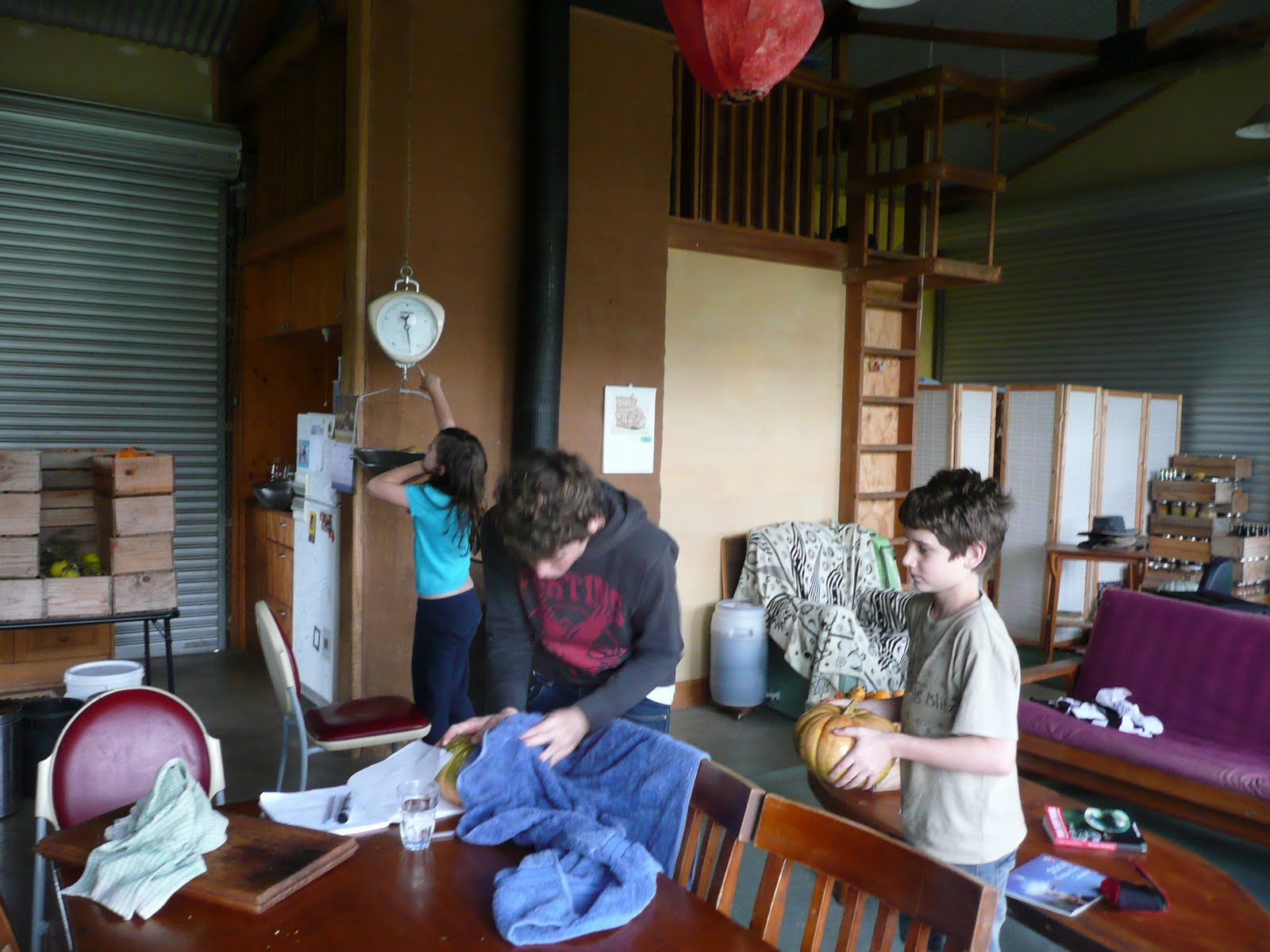
Marg and the kids came up for the weekend and we had fun using some team work to harvest and weigh half a ton of pumpkins.

It was a great experience. Hard work and great fun. We had some good conversations about the woes of the world. Wwoofing's a great opportunity to learn about a different way. Thanks David.

PS There's two types of people in this world, those who poo in drinking water and those who don't. So now I'm back home, I've made a 'lovable loo' compost toilet. Just add saw-dust.
Here's a blog from a local permi who's made the move out of town.
I ate 90% from the property I was working on - goats milk and meat, vegies and home-made beer. I was wwoofing at David Arnold's 8ha permaculture property,
Murnong, in Violet town, two hours north of Melbourne up the Hume Hwy.
David built a passive solar mud brick house with big north facing windows and farm sheds attached. The concrete slab floor heats up beautifully in the sun and radiates after dark. We made jams, lived off soups, fed and milked goats. Unlike my home, there was nothing for the recycling bin!
We chopped a dozen cassurinas that needed thining. Those remaining will now kick on. The timber was cut into logs and branches mulched for compost and later use on the orchard. It was good practice cutting the scarf (wedge), back cut and controlling the fall.
David's got an extensive orchard and the trees are in great condition.
Marg and the kids came up for the weekend and we had fun using some team work to harvest and weigh half a ton of pumpkins.
It was a great experience. Hard work and great fun. We had some good conversations about the woes of the world. Wwoofing's a great opportunity to learn about a different way. Thanks David.
PS There's two types of people in this world, those who poo in drinking water and those who don't. So now I'm back home, I've made a 'lovable loo' compost toilet. Just add saw-dust.
Here's a blog from a local permi who's made the move out of town.
Subscribe to:
Posts (Atom)